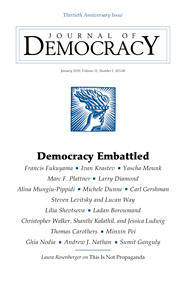


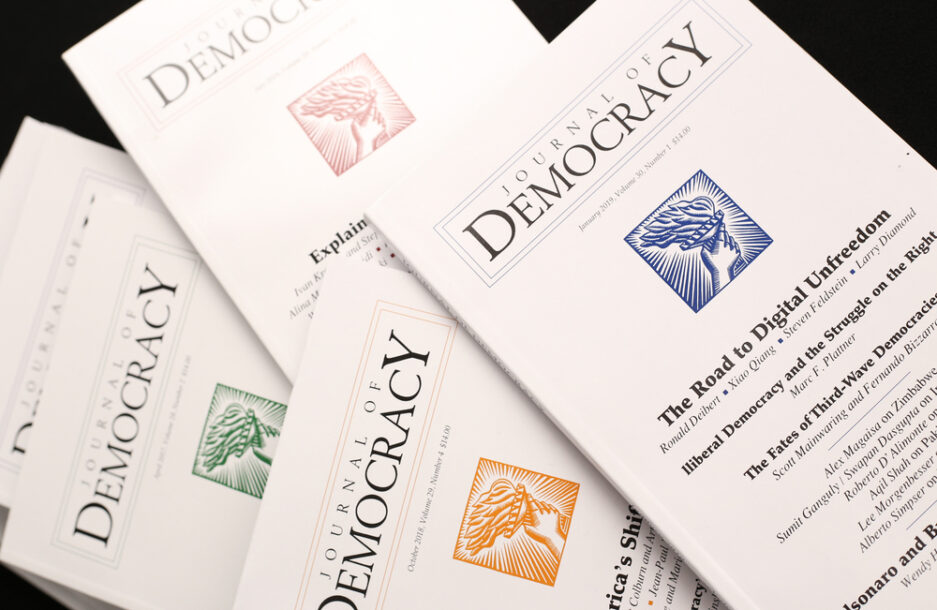
Founded in 1990, the Journal of Democracy is an influential quarterly journal which focuses on analyzing democratic regimes and movements around the world. The Journal is a branch of the International Forum for Democratic Studies at the National Endowment for Democracy, and is published by The Johns Hopkins University Press. Larry Diamond and Marc F. Plattner are its editors. [read more...]


Highlights — July 2010

A trio of articles explore recent developments in Afghanistan and Iraq, while a pair of essays examine the impact of corruption and the role of regionalism in Ukrainian politics in the wake of the 2010 presidential election. Other essays featured in the July issue include a comparative analysis of political attitudes in the Muslim world, an assessment of the state of democracy in the Democratic Republic of Congo, and a look at the recent elections in Chile. In addition, Alfred Stepan, Juan J. Linz, and Yogendra Yadav consider “The Rise of ‘State-Nations,’” and Jacques Rupnik offers a tribute to Václav Havel.

Free articles (PDF):

    The Democratic Instinct in the 21st Century
    Susilo Bambang Yudhoyono
    Democratization is never easy, smooth, or linear, but as Indonesia’s experience in building a multiparty and multiethnic democracy shows, it can succeed even under difficult and initially unpromising conditions.

    Lessons from Afghanistan and Iraq
    Zalmay Khalilzad
    After almost ten years of complex and costly efforts to build democracy in these two countries, where do things stand? What lay behind the critical choices that shaped events in these places, and what are their current prospects for success?

    Liberation Technology
    Larry Diamond
    The Internet, mobile phones, and other forms of “liberation technology” enable citizens to express opinions, mobilize protests, and expand the horizons of freedom. Autocratic governments are also learning to master these technologies, however. Ultimately, the contest between democrats and autocrats will depend not just on technology, but on political organization and strategy.

Highlights — April 2010

In this issue, Nathan Glazer explores how democracies manage the deep divides that exist in plural societies, while Lisa Anderson looks at life after office for world leaders, and Charles Kurzman and Ijlal Naqvi examine who wins elections in Muslim countries. Also featured are two articles on the state of democracy in Indonesia, a cluster on Central America, the 2009 Freedom House survey, an essay on democratic policing in postconflict countries, and more. For a full list of articles, click here.

Free articles (PDF):
    Democracy and Deep Divides
    By Nathan Glazer
    How do democracies deal with the deep divisions created by race, ethnicity, religion, and language? The cases of Canada, India, and the United States show that democratic institutions—notably, competitive elections and independent judiciaries—can bridge divides and build stability, but they must find a way to manage the tension between individual and group equality.

    Do Muslims Vote Islamic?
    By Charles Kurzman and Ijlal Naqvi
    Those who warn against efforts to promote free elections in Muslim-majority countries often point to the threat posed by Islamic parties that stand ready to use democracy against itself. But what does the record really show regarding the ability of Islamic parties to win over Muslim voters?
    Appendix

    The Ex-Presidents
    By Lisa Anderson
    What makes elected leaders step down at the appointed hour, and what do they have to look forward to once their terms end? A look at the political afterlives of world leaders tells us that the future prospects of presidents and premiers may well affect their behavior while in office.

Highlights — January 2010

The first issue of the new year marks the Twentieth Anniversary of the Journal of Democracy. Nine essays by top scholars such as Robert Putnam, Francis Fukuyama, Philippe C. Schmitter, Guillermo O'Donnell, and others, as well as our editors Marc F. Plattner and Larry Diamond, seek to shed light on "Democracy's Past and Future," while a shorter set of articles written by seven leading analysts seeks to draw out the lessons of "Twenty Years of Postcommunism."

Free articles (PDF):
    Democracy's Past and Future
    The Editors

    Populism, Pluralism, and Liberal Democracy
    By Marc F. Plattner
    In recent years, scholars have begun to focus on the sources of "authoritarian resilience." But democracy has also shown surprising resilience, in part because the disorders to which it is prone tend to counteract each other.

    Why Are There No Arab Democracies?
    By Larry Diamond
    Democracy has held its own or gained ground in just about every part of the world except for the Arab Middle East. Why has this crucial region remained such infertile soil for democracy?

Highlights — October 2009

The cluster "Iran in Ferment" looks at the turmoil in Iran following the disputed presidential election in June. A second group of essays explores the relationship between poverty, inequality, and democracy, particularly in Latin America and East-Central Europe. Other essays address elections in India and South Africa, postwar reconstruction, and more. And be sure to look for the latest volume in our book seriesDemocracy: A Reader.

Free articles (PDF):
    Iran in Ferment: The Green Wave
    By Ali Afshari and H. Graham Underwood
    Iran's massive protest movement against June's electoral coup is now moving into a new phase. What are its prospects?

    Iran in Ferment: Cracks in the Regime
    By Abbas Milani
    The Islamic Republic is struggling, with the Revolutionary Guard Corps more and more the only thing propping it up.

    Iran in Ferment: Civil Society's Choice
    By Ladan Boroumand
    When students and other rights activists decided to seize a tactical opening that the regime cynically offered them during the 2009 campaign, they were making a choice that was even more fateful than they knew.

    An Accidental Advance? South Africa's 2009 Elections
    By Steven Friedman
    The ANC saw its first-ever decline in vote share in South Africa's 2009 parliamentary elections. Will the ANC heed this warning to mend internal divisions and reconnect with voters?


Current Table of Contents

Quick Links
What's New
  • An Exchange on Nicaragua (web only): Samuel R. Greene comments on Leslie Anderson and Lawrence Dodd’s July 2009 essay, “Nicaragua: Progress Amid Regress?” and the authors respond.


  • "Democracy's Past & Future," a panel featuring Francis Fukuyama, Ivan Krastev, Moisés Naím, Larry Diamond, and Marc Plattner, celebrated the Journal's 20th anniversary.


  • The 2009 Seymour Martin Lipset Lecture on Democracy in the World, the sixth in an annual series, featured Nathan Glazer.
    [Watch the Event]


  • "Democracy, Totalitarianism, and the Culture of Freedom"—a memorial symposium honoring the life and work of Leszek Kolakowski, moderated by Zbigniew Brzezinski.
    [Watch the Event]


  • Democracy: A Reader, the latest volume in the Journal of Democracy's book series, appeared in September 2009.


  • The inaugural issue of the Journal of Democracy en Español, an annual publication, appeared in July 2009.


  • Panel discussion "Can Cuba Change?," featuring Eusebio Mujal-León, Carl Gershman, and Orlando Gutierrez, based on their articles in the January 2009 issue of Journal of Democracy.
    [Watch the Event]


  • The 2008 Seymour Martin Lipset Lecture on Democracy in the World, the fifth in the annual series, featured Jean Bethke Elshtain.
    [Watch the event]


  • The new Journal of Democracy book, How People View Democracy, was launched with the panel discussion "Public Opinion and Democracy: What Africans, Asians, and Arabs Think."
    [Watch the Event]


  • A panel discussion on the "State of Democracy in Latin America" marked the publication of Latin America's Struggle for Democracy, part of the Journal of Democracy book series.
    [Watch the Event]


||
|| Site map ||