April 2018, Volume 29, Issue 2
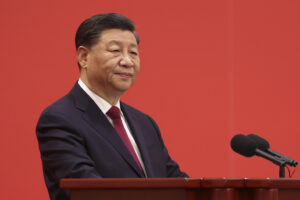
China in Xi’s “New Era”: The Return to Personalistic Rule
After Mao, Deng Xiaoping tried to institutionalize collective leadership, but this did not stop Xi Jinping from grasping all the levers of power.
April 2018, Volume 29, Issue 2
After Mao, Deng Xiaoping tried to institutionalize collective leadership, but this did not stop Xi Jinping from grasping all the levers of power.
April 2018, Volume 29, Issue 2
The ability of liberal democracies around the world to translate popular views into public policy has been declining. Yet there is no easy way to overcome this trend without weakening the capacity of governments to solve some of the most pressing challenges of the coming decades.
January 2018, Volume 29, Issue 1
Despite high hopes for progress toward democracy, the military’s power remains stubbornly entrenched, while Aung San Suu Kyi seems to lack the skills to run the government effectively.
January 2018, Volume 29, Issue 1
To safeguard their ill-gotten gains, kleptocrats rely on a web of transnational relationships and the complicity of Western fixers.
January 2018, Volume 29, Issue 1
Despite worries that terror groups can turn open societies’ very openness against them, the numbers reveal that liberal democracies enjoy significant advantages in resisting the threat of terrorism.
October 2017, Volume 28, Issue 4
“Democratic deconsolidation” on the level of attitudes and beliefs is real, and behind it lies a disturbing rise in tolerance for antisocial behavior, especially among the young.
October 2017, Volume 28, Issue 4
Under Vladimir Putin, Russia’s ruling class again claims to represent a superior alternative to liberal democracy. How can we theorize this regime? Putinism is a form of autocracy that is conservative, populist, and personalistic. Its conservatism means that Putinism prioritizes maintaining the status quo and avoiding instability. Conservatism also overlaps with Putinism’s populism in crowd-pleasing broadsides against gay rights and feminism, but gives…
October 2017, Volume 28, Issue 4
More Russians are rejecting the Kremlin’s corruption and authoritarianism. They—and not the regime—are Russia’s future.
July 2017, Volume 28, Issue 3
Analogies with interwar Europe are often misdirected. In the 1920s and 1930s, regime breakdowns occurred in struggling new democracies, but established democratic systems exhibited remarkable endurance.
July 2017, Volume 28, Issue 3
A look at liberal democracy’s complex historical evolution shows that elite fantasies of liberalism without democracy are ill-founded. Authoritarian legacies and democratic deficits lie at the core of trends that threaten liberal rights.
July 2017, Volume 28, Issue 3
Of late, Indian democracy has been confronted with a new political economy. Strong economic growth over the last three decades has generated the world’s fourth-largest collection of dollar billionaires and the third-largest middle class, both for the first time in Indian history, while still leaving the single largest concentration of the poor behind. In a…
April 2017, Volume 28, Issue 2
With the advance of modernization, nationalism was supposed to fade away. Yet everywhere we look, even in advanced democracies, nationalism’s influence seems larger than ever. What did we get wrong?
April 2017, Volume 28, Issue 2
The Editors’ introduction to “The 2016 U.S. Election.”
April 2017, Volume 28, Issue 2
Rising populism in the U.S. and beyond is calling into question the liberal-democratic bargain that has defined the postwar era. What led to Americans’ present revolt against elites, and what are its implications?
April 2017, Volume 28, Issue 2
Traditional intermediary institutions such as parties and the legacy media are not what they once were, and they are not coming back. What are the implications of new social media and digital-campaign techniques?
January 2017, Volume 28, Issue 1
Political scientists have long assumed that “democratic consolidation” is a one-way street, but survey evidence of declining support for democracy from across the established democracies suggests that deconsolidation is a genuine danger.
January 2017, Volume 28, Issue 1
The referendum campaign and its aftermath have exposed fault lines between the “two Britains” that have been long in the making and that pose stark questions about national values and identity.
January 2017, Volume 28, Issue 1
When parts of the Turkish military attempted a coup in July 2016, the competitive authoritarian AKP regime was able to bring both its competitive and its authoritarian features to bear, stopping the coup and launching a crackdown.
October 2016, Volume 27, Issue 4
Liberal democracy in Europe today is under siege from a variety of political forces, but it is critical to recognize the distinctions among them.
October 2016, Volume 27, Issue 4
What some had thought would be the “end of history” has instead turned out to be the “new world disorder.” Democratic liberalism may have no new ideological rival, but older identities are powerfully reasserting themselves.