
April 2017, Volume 28, Issue 2
What’s in a Name?
A review of What Is Populism? by Jan-Werner Müller.
1952 Results
April 2017, Volume 28, Issue 2
A review of What Is Populism? by Jan-Werner Müller.
April 2016, Volume 27, Issue 2
A review of Making Waves: Democratic Contention in Europe and Latin America Since the Revolutions of 1848 by Kurt Weyland.
October 1994, Volume 5, Issue 4
Reports on elections in Barbados, Belarus, Colombia, Dominican Republic, Guatemala, Guinea-Bissau, Mexico, Panama, Sri Lanka, Ukraine.
April 2016, Volume 27, Issue 2
Guatemala, Honduras, and El Salvador are weighed down by high crime, sluggish economies, and heavy reliance on remittances. And when significant political change has taken place, it has resulted in frightening political fragmentation.
October 2015, Volume 26, Issue 4
Can decentralization deepen democracy or is it doomed to weaken the state? If well designed, decentralization can have a positive impact on national unity, conflict mitigation, policy autonomy, service delivery, and social learning.
July 2003, Volume 14, Issue 3
Liberty and self-government are not only good in themselves, but also have powerful and beneficial effects on a nation’s level of economic development and prosperity.
January 2003, Volume 14, Issue 1
October 2002 brought the latest in a series of “critical” elections that have helped to point the way to an independent, more democratic future.

October 2024, Volume 35, Issue 4
After thirty years of ANC dominance, the 2024 elections have ushered in multiparty politics in South Africa. Will the party’s centrist shift be enough to stop its descent, or is it destined to fracture further?
April 1994, Volume 5, Issue 2
Excerpts from: speeches by ANC President Nelson Mandela and South African President F.W. De Klerk from the International Press Institute’s 43rd General Assembly; a UN General Assembly resolution criticizing the continuing denial of human rights and democracy in Burma (Myanmar).
Winter 1990, Volume 1, Issue 1
The Journal of Democracy seeks to bridge some of these gaps. We hope that it will help to unify what is becoming a worldwide democratic movement. But like genuine democracy itself, the journal will be pluralistic. Its pages will be open to a wide variety of perspectives and shades of opinion, and it will seek…
“The Journal of Democracy is far and away the most important forum for current debates about the nature and spread of liberal democracy around the world, and an indispensable tool for anybody interested in comparative politics or international relations. It is a model for how to present serious intellectual content in a clear and accessible…

Turkey’s president would rather turn his country into a full autocracy than give up power. But the Turkish people are clinging to what remains of their democracy, and they are ready to fight for it.

Leading experts explain the significance of Prigozhin’s rebellion and what it means for Putin, his regime, and the ongoing war in Ukraine.

The economy is spiraling, public frustration is mounting, and the regime is becoming more repressive. The next time Egyptians come to the streets, they will be looking for more than promises and free elections.
July 1998, Volume 9, Issue 3
To understand how India’s democracy works, and how it manages demands from social groups for greater power, resources, autonomy, and respect, it is essential to understand Indian federalism. That, in turn, requires us to address two questions. First, why have relations between New Delhi and the various state governments (there are at present 25) usually…
Subscribe to the Quarterly Published in January, April, July, and October. Subscribe electronically and receive full access to our archives on Project MUSE ($60 for a one-year subscription), or sign up to receive our quarterly issues in print ($50). For more information on individual as well as institutional subscription options, visit our subscriptions page at…
Johns Hopkins University Press handles all permissions matters for the Journal of Democracy. Written permission is required to reproduce material from Johns Hopkins University Press publications in other publications, coursepacks, electronic products, or other media. To request permission to translate or reprint material from the Journal, visit the JHUP permissions site and complete the Reprint…
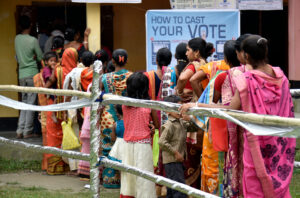
National politics is increasingly overshadowing everything else, even as local government does more and more. Here’s how to right the balance. | By Eguiar Lizundia and Utpal Misra
The Journal of Democracy seeks essays that offer clear and compelling perspectives on the emergence, survival, and deepening of democratic norms and institutions. Submissions or pitches should thus be targeted to the Journal’s broad, global audience, and should avoid overly specialized terminology or jargon. Essays that feature quantitative analyses are welcome, but they must be…

The popular Chinese-owned app is helping Beijing collect people’s data everywhere, and giving it control over powerful tools that can shape their worldview. | Aynne Kokas